
By Spread Love.org Editorial Team | Last updated: October 2026

—
Key Takeaways
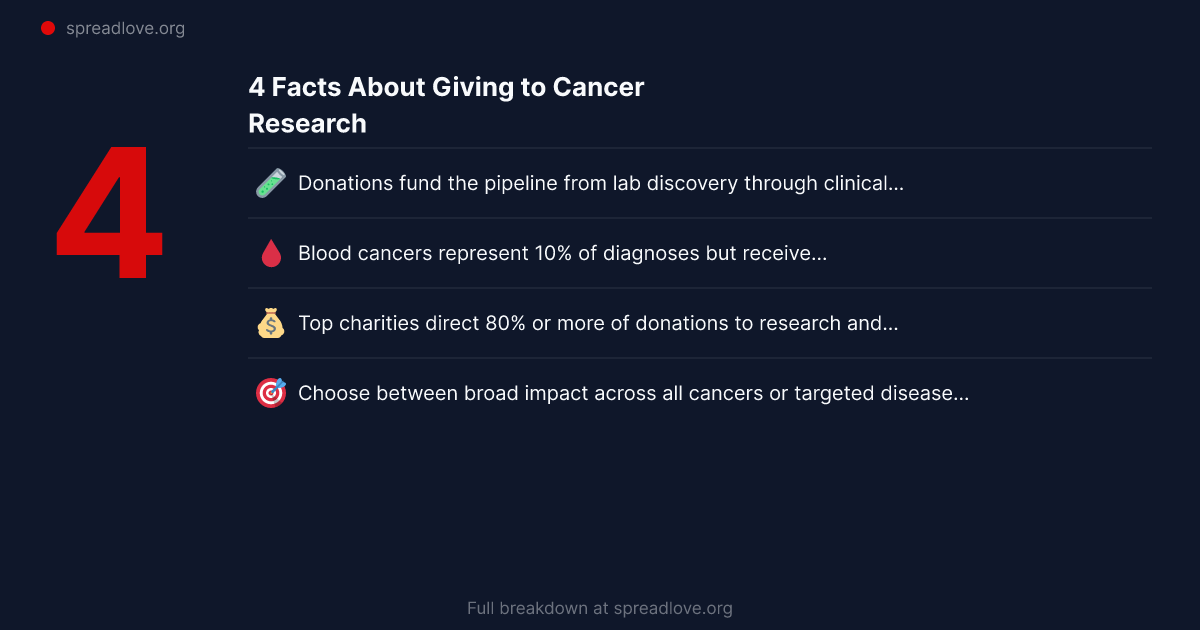
- Cancer research donations fund the full pipeline from early laboratory discovery through clinical trials, covering costs like researcher salaries, lab equipment, patient recruitment for studies, and the years of testing required before a new treatment reaches hospitals.
- Blood cancers account for roughly 10% of all new cancer diagnoses in the United States each year, yet blood cancer research receives a disproportionately small share of philanthropic funding.
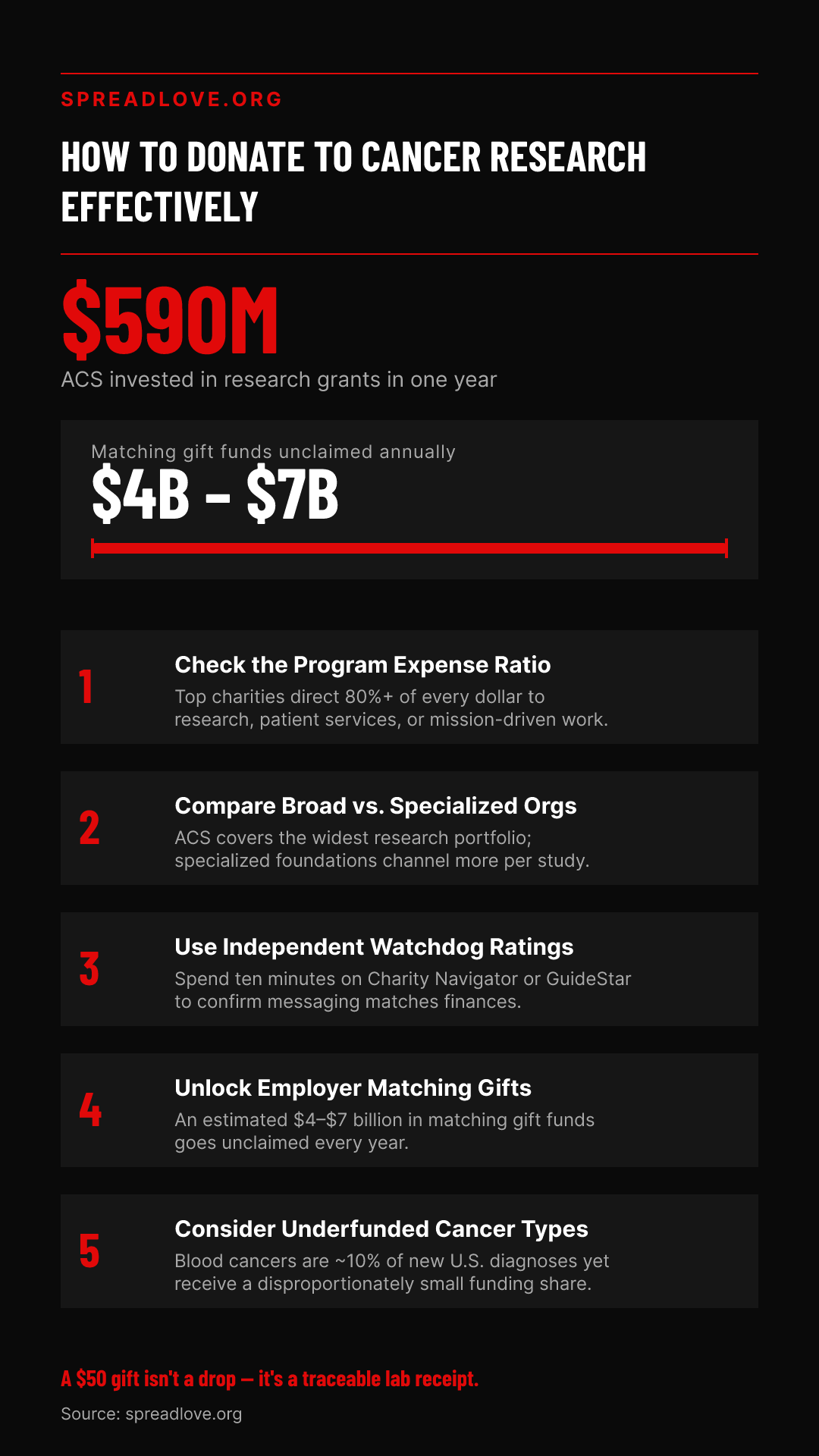
- A charity’s program expense ratio reveals what percentage of every donated dollar actually reaches research, patient services, or mission-driven work, and top performers direct 80% or more to programs.
- The best organization to donate to for cancer research depends on whether you prioritize broad impact across many cancer types or targeted funding for a specific disease.
—
According to the American Cancer Society’s 2024 annual report, ACS invested over $590 million in cancer research grants and programs in a single year. But here’s what doesn’t make the headlines: for every dollar the federal government spends on cancer research, philanthropic donations from individuals fill gaps that public funding can’t cover.
A $50 gift isn’t a drop in the ocean. It’s a traceable contribution to a specific study. Yet the sheer number of organizations asking for your money in 2026 can feel paralyzing. This guide covers the organizations directing the highest percentage of funds to research, shows you how to evaluate any charity before you give, and spotlights a critically underfunded area. If you’re exploring other ways to create change, our social good projects page covers initiatives across multiple causes.
—
How to Donate to Cancer Research When It Matters Most
Learning how to donate to cancer research is straightforward , identify a trusted organization, choose a one-time or recurring gift, and direct your contribution where it’s needed most. Spread Love.org makes this easy by connecting donors with vetted initiatives, including underfunded areas like blood cancer research, where even modest contributions can accelerate breakthroughs from lab to treatment.
—
Top Cancer Research Organizations Worth Your Support
The best organization to donate to for cancer research depends on whether you prioritize broad impact across many cancer types or targeted funding for a specific disease, with the American Cancer Society covering the widest research portfolio and specialized foundations like Blood Cancer United and the Breast Cancer Research Foundation channeling higher percentages directly into lab work.
National Organizations
The American Cancer Society (ACS) supports over 600 active research grants spanning every major cancer type, alongside patient services and public health advocacy. Because ACS runs extensive patient programs alongside research, the percentage reaching the lab is lower than at research-only organizations. That’s not a flaw. It’s a design choice.
St. Jude Children’s Research Hospital funds both treatment and research, and families never receive a bill. If childhood cancer is your priority, St. Jude’s integrated model is hard to beat.
The National Cancer Institute, as the federal government’s primary agency for cancer research, funds and conducts studies across every cancer type, though individual donors typically support NCI-designated cancer centers rather than the agency itself.
| Organization | Primary Focus | Notable Strength |
|---|---|---|
| American Cancer Society | All cancers + patient services | 600+ active research grants |
| St. Jude Children’s Research Hospital | Pediatric cancers | No-cost treatment model |
| National Cancer Institute | All cancers (federal) | Sets national research agenda |
| Blood Cancer United | Blood cancers | High research-to-overhead ratio |
| Breast Cancer Research Foundation | Breast cancer | ~91 cents per dollar to programs |
Specialized Foundations
For donors who want to target a specific cancer type, specialized foundations like the Breast Cancer Research Foundation direct roughly 91 cents of every dollar to research and public health programs, making them among the most research-efficient charities in the oncology space. The tradeoff is reach: they fund fewer total studies, but each gets a larger share of available funds. For donors who want depth over breadth, that’s a solid deal.
—
How to Evaluate a Cancer Charity Before You Donate
The best charity to donate to for cancer research is the one whose program expense ratio, independent watchdog ratings, and research focus align with the specific cancer type and level of transparency that matter most to you as a donor. Before you give a single dollar, spend ten minutes checking three things: how much reaches programs, whether watchdogs have flagged concerns, and whether the organization publishes clear financials. Those ten minutes can be worth their weight in gold.
You can learn more about how transparent organizations operate by visiting our About page.
| Metric | What It Tells You | Green Flag | Red Flag |
|---|---|---|---|
| Program expense ratio | % reaching mission work | 75%+ | Below 60% |
| Fundraising efficiency | Cost to raise each dollar | Under $0.25 | Over $0.50 |
| CEO compensation | Pay relative to budget | Proportional to org size | Outlier vs. peers |
| Financial transparency | Willingness to share data | GuideStar Platinum/Gold | No seal, no public 990 |
| Independent rating | Third-party score | 3+ stars on Charity Navigator | Unrated or below 2 |
Arguably, the smartest approach is a split: direct a portion to a trusted national organization and another to a specialized program that resonates personally. Don’t fly blind. Ten minutes on Charity Navigator or GuideStar can confirm whether messaging matches financial reality.
—
Step-by-Step Guide to Making Your First Donation Online
Most major cancer charities accept online donations in under five minutes, with options for one-time gifts, recurring contributions, and designated giving to specific cancer types.
- Choose your organization. Visit the official website directly, not third-party aggregators that sometimes skim processing fees.
- Find the donation page. Look for “Donate” or “Give Now” in the top navigation.
- Select amount and frequency. Even $25 per month adds up to $300 annually.
- Enter payment information. Credit cards, debit cards, and PayPal are standard. Some organizations accept donor-advised fund transfers.
- Verify tax-deductibility. Confirm the organization is a registered 501(c)(3).
- Save your confirmation receipt. You’ll need it for tax deductions.
And here’s the step most guides skip: if you want your gift directed to a specific cancer type, contact donor services before giving. A quick email confirms whether the organization honors fund designations or pools restricted gifts into general budgets. Smaller organizations like Blood Cancer United eliminate this ambiguity entirely because they focus on one area.
—
Maximize Your Impact Beyond a Single Donation
Employer matching is one of the most underused tools in cancer philanthropy. According to Double the Donation’s 2025 research, an estimated $4 to $7 billion in matching gift funds goes unclaimed every year. A $50 donation becomes $100 with zero extra effort.
Here’s the paradox of cancer research funding: sometimes the most impactful thing you can do costs nothing. Volunteering with clinical trial coordination, writing elected officials about research funding, and sharing evidence-based information during awareness months all contribute meaningfully. Exploring initiatives like Social Good Projects can show how individual action fits into larger movements.
—
Frequently Asked Questions
What organizations put the highest percentage of donations toward research?
Breast Cancer Research Foundation consistently ranks among the highest, directing over 80% of funds to research and earning top marks from Charity Navigator. Blood Cancer United also channels a significant share directly into research. That said, overhead ratio alone doesn’t define effectiveness. Administrative costs cover grant management, compliance, and donor communication.
How can I ensure my donation goes to a specific type of cancer research?
Most major charities let you designate your gift via a dropdown menu during checkout. Before giving, contact donor services to confirm they honor restricted designations, as some charities pool designated gifts into general funds below certain thresholds. Organizations focused on a single disease type eliminate this ambiguity entirely.
What is the most effective way to donate to cancer research?
Recurring monthly donations provide researchers with predictable funding, which is often more impactful than one-time gifts. Predictable revenue lets labs plan multi-year studies without worrying about funding gaps mid-project. Beyond recurring gifts, take advantage of employer matching and choose organizations with strong program expense ratios.
Which cancer research organizations are the most trustworthy?
American Cancer Society, St. Jude, Breast Cancer Research Foundation, and National Cancer Institute are widely regarded as trustworthy based on watchdog ratings, research output, and financial transparency. Verify any organization on Charity Navigator, GuideStar (now Candid), and the BBB Wise Giving Alliance. If an organization makes it difficult to find its financials, that’s a signal worth paying attention to.
How does St. Jude use cancer donations?
St. Jude directs donations toward pediatric cancer research and covers all treatment costs for patients’ families. No family ever receives a bill for treatment, travel, housing, or food. Beyond direct care, St. Jude operates one of the largest pediatric cancer research programs in the world, and its open-access data sharing means discoveries benefit children at hospitals everywhere.
Are American Cancer Society donations tax-deductible?
Yes, ACS is a registered 501(c)(3) nonprofit, so donations are tax-deductible subject to IRS guidelines. Keep your email confirmation receipt as proof. For gifts over $250, the IRS requires written acknowledgment from the charity. ACS provides donation receipts automatically after every online transaction.
—
Can I donate to blood cancer research specifically?
Yes, organizations like Blood Cancer United and the Leukemia and Lymphoma Society focus specifically on blood cancer research. Donors can also designate gifts to blood cancer programs at larger charities, allowing you to direct your contribution toward this particular research area even when giving to a broader organization.
Is it better to donate to large cancer charities or university research labs?
Both options create impact, but they serve different purposes. Large charities fund broad programs and patient support services, while university labs target specific studies and investigator-led research. Large charities typically offer more donor protections, standardized tax documentation, and transparency through established nonprofit oversight.
What should I look for in a cancer charity’s overhead ratio?
A program expense ratio of 75% or higher is generally considered efficient, meaning at least three-quarters of your donation reaches research, patient services, or mission work. However, overhead covers essential operations like compliance, fundraising, and staff—extremely low overhead can actually signal underinvestment in organizational capacity and sustainability.
How do I make a cancer research donation online for the first time?
Visit the charity’s official website and select your donation amount, then choose between a one-time or recurring gift. Enter your payment information securely, designate your gift if options are available, and save the tax receipt confirmation sent to your email for your records.
Your Next Move
Cancer research doesn’t move in straight lines. It zigzags through failed hypotheses, unexpected breakthroughs, and years of validation before a discovery reaches a patient.
Frankly, the best time to start giving was yesterday. The second best time is right now. Pick one organization you trust, verify its financials, and make your first gift. It doesn’t have to be large. It just has to be real.
—
By Spread Love.org Editorial Team | Last updated: October 2026
The Spread Love.org Editorial Team covers philanthropy, social impact, and community-driven giving. Our writers research nonprofit effectiveness, donor education, and emerging trends in charitable giving to help readers make informed decisions. Learn more on our About page.