
By Spread Love.org Editorial Team | Last updated: October 2026
—
Key Takeaways
- The ten most powerful women in the world in 2026 span politics, business, culture, and activism across six continents, and their influence is measured not just by title but by the systemic change they drive.
- Power without social impact is just position, and position without purpose is just a nameplate on a door.
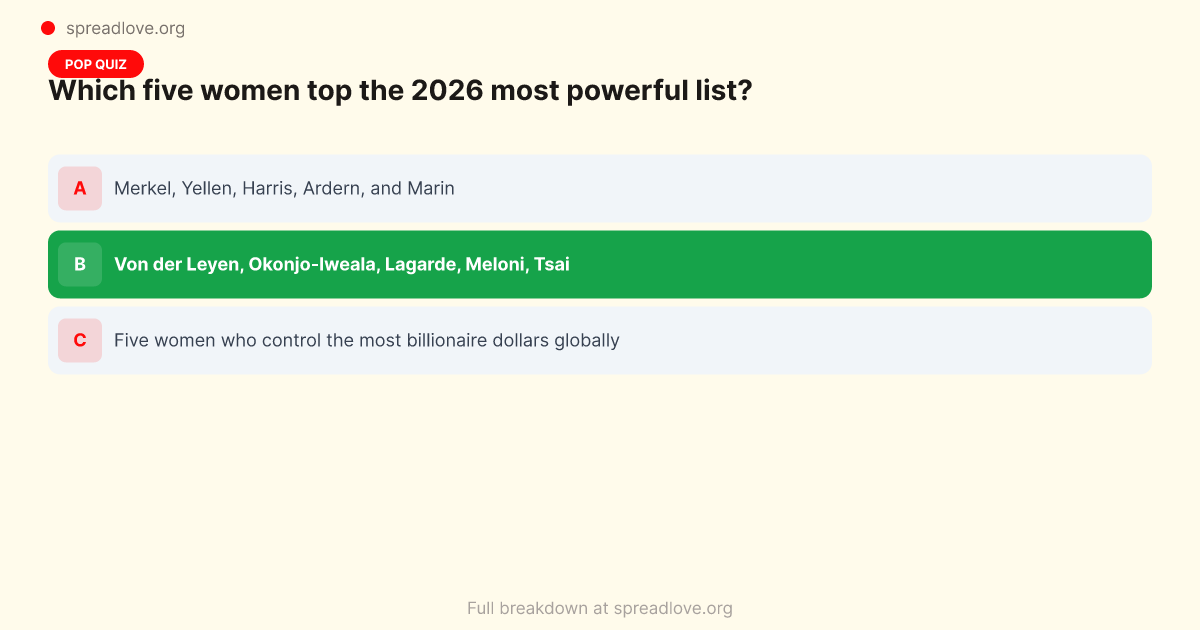
- The top five most powerful women in the world in 2026 are Ursula von der Leyen, Ngozi Okonjo-Iweala, Christine Lagarde, Giorgia Meloni, and Tsai Ing-wen, each commanding influence that reshapes policy, trade, and governance on a global scale.
- Most mainstream rankings skew toward Western, English-speaking figures, overlooking leaders from Africa, Asia, and Latin America whose impact rivals their Western counterparts.
—
Most lists of influential women get it wrong. They rank by job title, net worth, or proximity to a head of state, then call it a day. A billionaire who hoards influence and a grassroots organizer who transforms millions of lives don’t belong on the same scale, yet conventional rankings flatten them into one.
Here’s the contrarian take for 2026: the most influential women aren’t necessarily the ones with the biggest offices. They’re the ones whose decisions ripple outward, changing systems, shifting culture, and lifting communities that traditional structures have ignored. That’s harder to measure, which is exactly why most publications don’t bother. If you’re interested in how individual achievement connects to social good projects that benefit entire communities, you’re in the right place.
How Power Is Defined for Women Leaders
The ten most powerful women in the world in 2025 share a striking pattern: those who lead with purpose accumulate influence far beyond those who chase power for its own sake. Their impact spans policy, economic weight, and cultural reach , the three lenses we use to evaluate this list , plus a fourth dimension most rankings overlook: measurable social impact on the communities they serve, a value at the heart of what Spread Love.org champions every day.
The Ten Most Powerful Women in the World Today
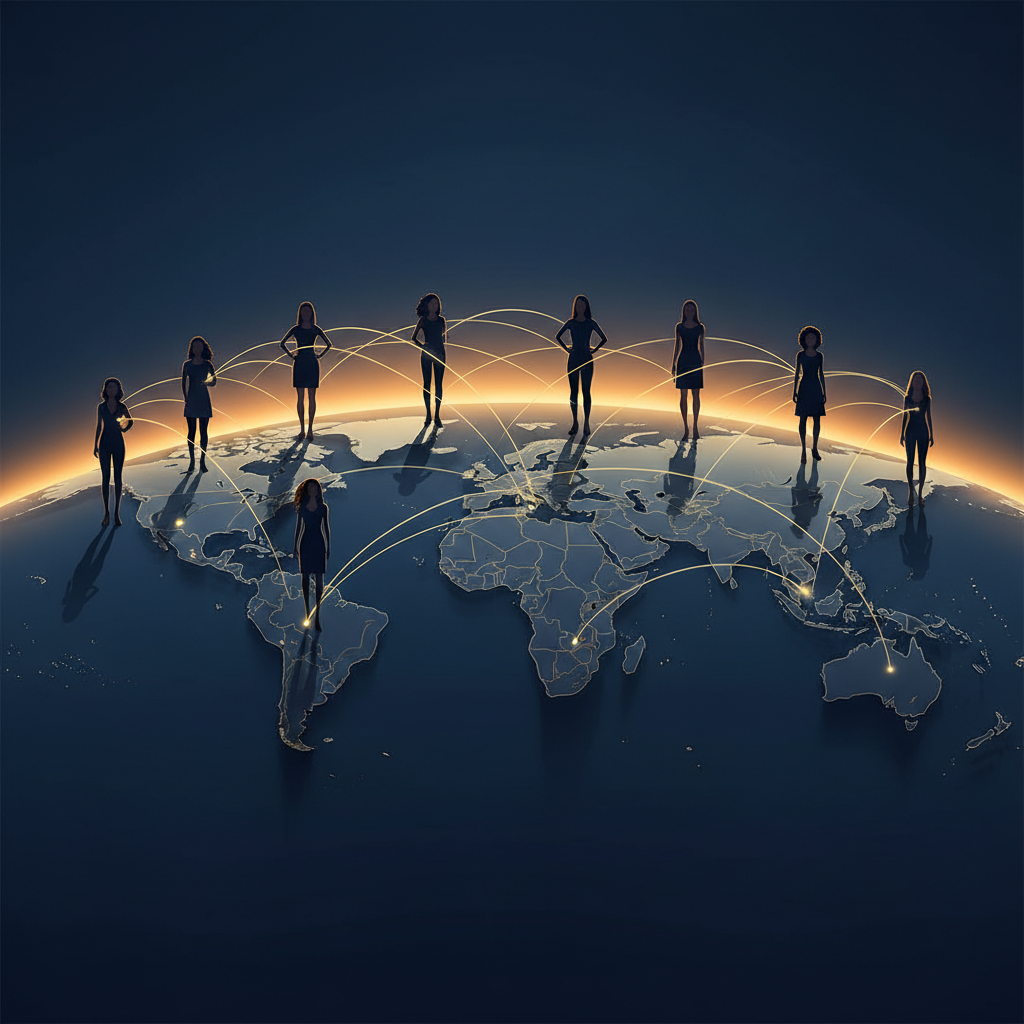
The ten most powerful women in the world in 2026 span politics, business, culture, and activism across six continents, and their influence is measured not just by title but by the systemic change they drive. This isn’t a recycled Forbes list. It’s a selection built on the reach-impact-legacy framework, with deliberate attention to regional diversity and social good.
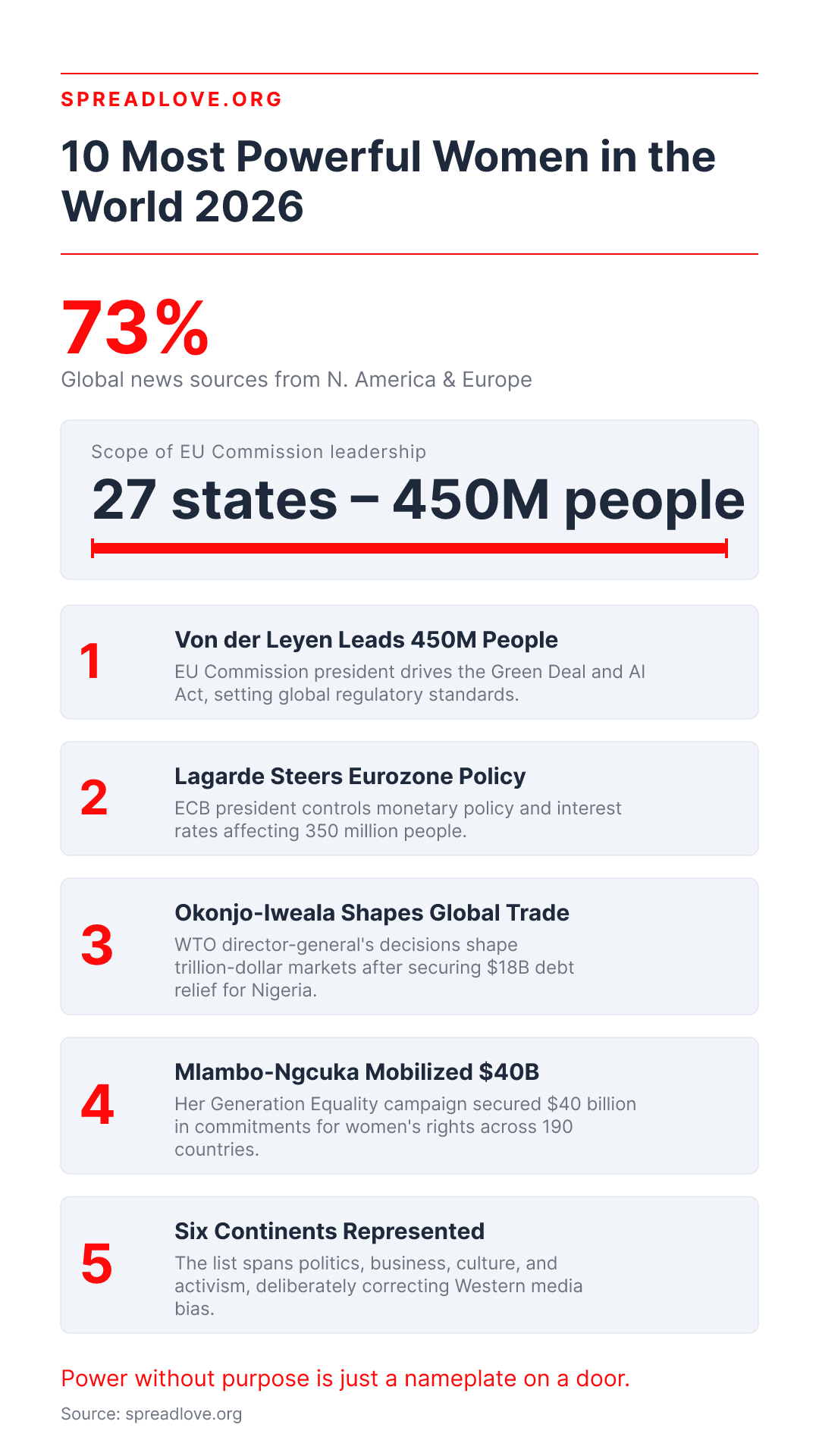
The top five most powerful women in the world in 2026 are Ursula von der Leyen, Ngozi Okonjo-Iweala, Christine Lagarde, Giorgia Meloni, and Tsai Ing-wen, each commanding influence that reshapes policy, trade, and governance on a global scale.
Leaders in Politics and Governance
1. Ursula von der Leyen, President of the European Commission. Von der Leyen directs policy for 27 member states and roughly 450 million people. Her leadership on the European Green Deal and the EU’s AI Act has positioned Europe as the global regulatory standard-setter on two of the decade’s defining issues.
2. Christine Lagarde, President of the European Central Bank. Lagarde controls monetary policy for the eurozone, influencing interest rates and economic stability for 350 million people. Few people on earth have held that much sustained economic authority.
3. Giorgia Meloni, Prime Minister of Italy. Love her politics or not, Meloni’s rise as Italy’s first female prime minister and her growing G7 influence make her impossible to exclude.
4. Tsai Ing-wen, Former President of Taiwan. Though her term concluded in 2024, Tsai’s legacy remains enormous. She steered Taiwan through its most tense period with mainland China in decades while strengthening the island’s semiconductor industry, which supplies over 60% of the world’s advanced chips, according to the Semiconductor Industry Association.
5. Sahle-Work Zewde, President of Ethiopia. Africa’s only current female head of state, Sahle-Work has championed gender parity in her cabinet and pushed for women’s inclusion in peace negotiations across the Horn of Africa.
Trailblazers in Business, Culture, and Activism
6. Ngozi Okonjo-Iweala, Director-General of the World Trade Organization. The most powerful women in business in 2026 include leaders like Ngozi Okonjo-Iweala, who directs the World Trade Organization, and whose decisions shape trillion-dollar markets. Her previous tenure as Nigeria’s finance minister, where she negotiated an $18 billion debt relief deal, proved economic authority and social good aren’t mutually exclusive.
7. Nemonte Nenquimo, Indigenous Rights Activist, Ecuador. Nenquimo led the Waorani people’s legal victory against oil extraction in the Ecuadorian Amazon, protecting half a million acres of rainforest. You don’t need a corner office to move the needle.
8. Phumzile Mlambo-Ngcuka, Former Executive Director of UN Women. Her “Generation Equality” campaign mobilized $40 billion in commitments for women’s rights across 190 countries.
9. Fei-Fei Li, Co-Director of Stanford’s Human-Centered AI Institute. As AI reshapes every industry, Li’s work on ethical AI and advocacy for diverse representation in tech leadership make her one of the most consequential voices in the field. She isn’t just studying the future. She’s building guardrails for it.
10. Vanessa Nakate, Climate Activist, Uganda. Nakate rose to prominence after being cropped out of a photo with white climate activists at Davos, crystallizing the erasure of African voices in the climate movement. Since then, she’s built the Rise Up Movement, installed solar panels in Ugandan schools, and become a UNICEF Goodwill Ambassador. Her story connects directly to the idea that listening more and talking less can reveal perspectives the world desperately needs.
| Rank | Name | Domain | Region | Key Impact |
|---|---|---|---|---|
| 1 | Ursula von der Leyen | Politics | Europe | EU Green Deal, AI Act |
| 2 | Christine Lagarde | Finance/Policy | Europe | Eurozone monetary policy |
| 3 | Giorgia Meloni | Politics | Europe | First female Italian PM, G7 influence |
| 4 | Tsai Ing-wen | Politics/Tech | Asia | Taiwan semiconductor strategy |
| 5 | Sahle-Work Zewde | Politics/Diplomacy | Africa | Gender parity, peace diplomacy |
| 6 | Ngozi Okonjo-Iweala | Trade/Economics | Africa | WTO leadership, equitable trade |
| 7 | Nemonte Nenquimo | Activism/Environment | Latin America | Indigenous rights, Amazon protection |
| 8 | Phumzile Mlambo-Ngcuka | Gender Policy | Africa | $40B Generation Equality commitments |
| 9 | Fei-Fei Li | Technology/AI | Asia/North America | Ethical AI, diverse tech leadership |
| 10 | Vanessa Nakate | Climate Activism | Africa | Rise Up Movement, clean energy access |
Why Most Power Lists Skew Western and How to Fix It
Most mainstream rankings suffer from a structural bias that’s pretty easy to spot: they’re compiled by Western media outlets, written in English, and distributed through channels prioritizing figures already familiar to Western audiences. The result is a feedback loop where the same American and European women appear on every list while leaders driving comparable change in the Global South remain invisible.
A 2023 analysis by the Reuters Institute for the Study of Journalism found that 73% of named sources in global news coverage come from North America and Europe. That media imbalance directly shapes which women get recognized. Fixing it requires expanding criteria beyond political office and corporate rank to include cultural influence, grassroots mobilization, and measurable community outcomes. And the sourcing has to be intentional. The question isn’t whether women in Africa and Asia hold real influence. It’s why we’ve been so slow to say so.
Most Powerful Women of All Time vs. Today
The debate over history’s most influential woman reveals how our criteria have shifted dramatically across centuries. Cleopatra VII wielded diplomatic strategy that kept Rome’s most formidable generals off balance for decades. Empress Wu Zetian remains the only woman in Chinese history to hold the title of Emperor. Queen Elizabeth I transformed England into a global maritime force, and her refusal to marry was itself a radical act of political independence.
But here’s a second paradox worth sitting with: the women history remembers as most influential are often the ones who operated within systems designed to exclude them, bending those systems until they broke open.
Today’s leaders build on those foundations with tools their predecessors couldn’t have imagined. A single social media post from Malala Yousafzai reaches more people in an hour than Cleopatra could have addressed in a lifetime. The question has shifted from “can a woman hold this position?” to “how does a woman’s leadership reshape the institution itself?” That’s solid progress, even if it’s incomplete.
Connecting Individual Power to Collective Impact
Influence that doesn’t flow outward isn’t influence at all. It’s just status.
According to UN Women’s research on gender equality, closing the gender gap in labor force participation could add $28 trillion to global GDP. That’s not an abstract number. It represents schools built, diseases treated, families stabilized.
Frankly, any list that ranks women by wealth or title alone misses the point. Influence measured by lives improved is the only metric that holds up across centuries. Learning to listen more, talk less is one of the underappreciated qualities separating leaders who accumulate authority from leaders who deploy it for good. That’s a no-brainer principle, and it connects individual achievement to the kind of social good projects that create lasting collective impact.
—
Frequently Asked Questions
Who qualifies as the most powerful woman alive right now?
As of 2026, European Commission President Ursula von der Leyen and ECB President Christine Lagarde consistently top global rankings due to their combined political and economic influence over hundreds of millions of people. Qualification depends on how you blend criteria. A head of state controls policy directly, while a cultural leader shapes public opinion at comparable scale. The most credible answer weighs political authority, economic influence, and cultural reach together rather than privileging one dimension.
Do we measure power by political influence, wealth, or cultural impact?
True influence is measured by a combination of all three, and isolating any single metric produces a distorted picture. A scored framework weighing reach, impact, and legacy across these dimensions provides a more honest assessment than any one-dimensional ranking. Context matters: a billionaire philanthropist and a grassroots activist wield fundamentally different kinds of authority, but both can reshape systems.
Why do most lists of powerful women skew toward Western figures?
Media bias and English-language dominance are the primary drivers. Most major publications producing rankings are headquartered in the United States or Western Europe, creating a feedback loop where Western women receive more coverage and more list placements. Broadening criteria and sourcing from regional media in Africa, Asia, and Latin America reveals equally influential women whose impact rivals any Western counterpart.
Who is considered the most powerful woman of all time?
The answer depends entirely on the criteria. Queen Elizabeth I is frequently named for transforming England into a global force. Empress Wu Zetian holds a strong claim as the only woman to rule China as Emperor. Cleopatra VII’s diplomatic mastery preserved Egyptian sovereignty against Rome. The answer shifts based on whether you prioritize military conquest, institutional change, scientific contribution, or cultural influence persisting across centuries.
What qualities define a truly powerful woman beyond holding office?
Resilience, vision, and the ability to mobilize communities define authority beyond titles. Think of Malala Yousafzai, who transformed personal tragedy into a global education movement, or Wangari Maathai, whose Green Belt Movement planted over 51 million trees across Kenya without any governmental mandate. Titles are temporary. Impact is the real measure.
How does women empowerment connect to global social good?
Women who gain real authority drive measurable improvements in education, health, and economic growth. When women control household income, spending on nutrition and healthcare increases. Data from organizations like the World Bank and UN Women consistently confirms that investing in women’s leadership is arguably the highest-return investment any society can make.
Are there powerful women leaders from Africa and Asia on global lists?
Yes, and their representation is growing. Ngozi Okonjo-Iweala leads the WTO. Sahle-Work Zewde serves as Ethiopia’s president. Tsai Ing-wen’s presidency steered one of the most complex geopolitical situations in the world. The issue isn’t a shortage of influential women in these regions. It’s a shortage of lists willing to look beyond London, Washington, and Brussels.
How has the definition of a powerful woman changed over time?
Historical definitions centered almost exclusively on royal or military authority. The modern definition has expanded to include economic clout, cultural capital, grassroots mobilization, and technological influence. Authority no longer concentrates solely in governments. It flows through networks, platforms, and communities, and women are claiming it in all of those spaces.
—
Has any single woman been more influential to humanity than others?
Influence at a civilizational scale is inherently debatable and deeply context-dependent, shaped by the era, region, and metrics used to measure impact. Historical figures like Marie Curie transformed scientific understanding, while leaders like Eleanor Roosevelt reshaped human rights discourse, and contemporary activists have mobilized millions on climate and social justice—each representing a different dimension of human influence. No single woman dominates across all domains because power operates through different systems: political authority, intellectual contribution, cultural reach, and grassroots mobilization each create distinct spheres of influence. The most honest answer is that influence cannot be ranked on a single scale; it can only be understood through the specific changes each woman catalyzed in her time and field.
What is the difference between power and influence for women leaders?
Power is the structural ability to make decisions and direct resources, while influence is the capacity to shape how others think, decide, and act—often without formal authority. The most impactful women leaders wield both simultaneously: they hold positions that grant them decision-making power while simultaneously commanding the respect, trust, or attention that allows them to influence behavior far beyond their official mandate. A woman with only power may implement policy, but a woman with both power and influence can shift culture and create lasting systemic change. This dual capacity is what distinguishes those who hold a title from those who transform institutions.
Where This Is Heading
By 2026, women in AI and technology leadership are emerging as a new category of authority that most traditional lists haven’t caught up with. As African and Asian economies grow, the women leading those transformations will become impossible to ignore.
Question every ranking you encounter. Ask what criteria were used, whose perspective shaped the selections, and who got left out. Seek out stories of women leading change in regions that don’t get mainstream coverage. And recognize that authority, at its best, isn’t something held. It’s something shared.
The most influential women in the world have always known that. The rest of us are still catching up.
—
By Spread Love.org Editorial Team | Last updated: October 2026
The Spread Love.org Editorial Team covers stories of leadership, community impact, and human connection. Our work focuses on amplifying voices that drive social good and exploring how individual action creates collective change. Learn more at Spread Love.org.