
By Spread Love.org Editorial Team | Last updated: October 2026
—
Key Takeaways
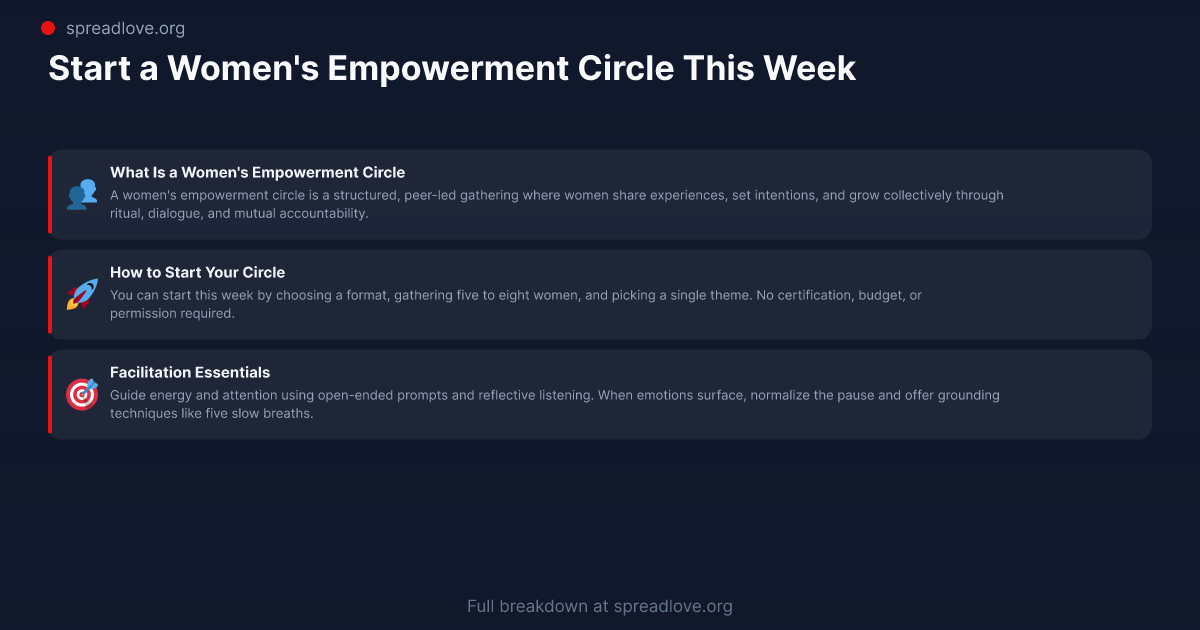
- A women’s empowerment circle is a structured, peer-led gathering where women come together to share experiences, set intentions, and grow collectively through ritual, dialogue, and mutual accountability.
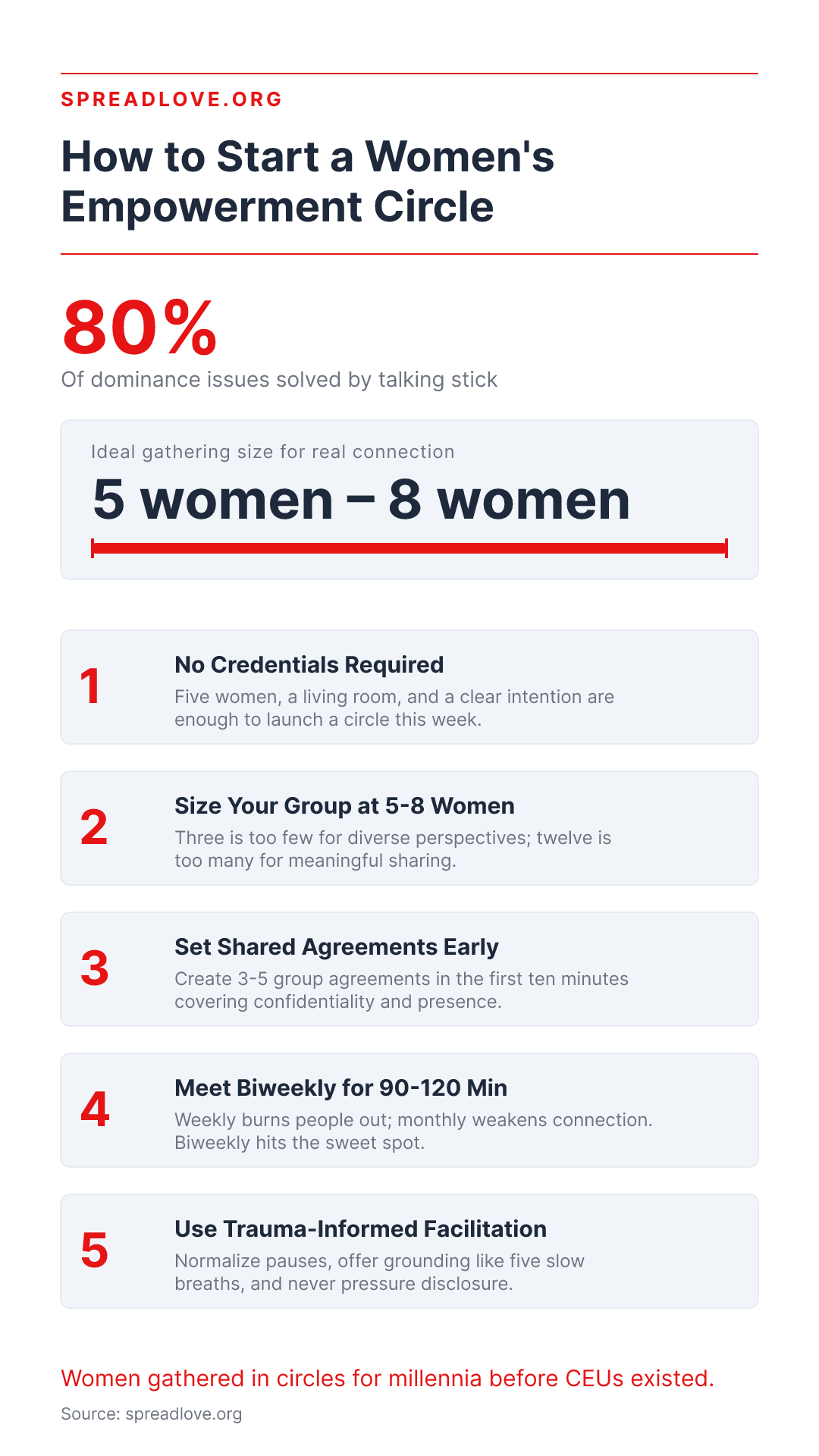
- You don’t need a certification, a coaching license, or a paid program to start one. Five women, a living room, and a clear intention are enough.
- The biggest difference between a circle that fizzles after two meetings and one that lasts years is the presence of shared agreements and intentional rituals, not the facilitator’s resume.
- Trauma-informed facilitation isn’t optional. Preparing grounding techniques and knowing when to pause protects every woman in the room.
- Virtual circles are a legitimate format, not a lesser substitute, and they open the door for women who can’t attend in person.
—
Most guides on starting a women’s empowerment circle begin with the same advice: get certified first. Buy someone’s curriculum. Honestly? That gatekeeping is one of the biggest reasons more circles don’t exist in 2026. Women have been gathering in circles for thousands of years, long before anyone invented a certification for it.
The circles that thrive aren’t led by the most credentialed facilitator. They’re led by the most intentional one. You can start this week with no budget and no one’s blessing. What you need is a clear understanding of what a circle actually is, how to structure it, and how to hold the room when emotions get real. The Spread Love.org blog exists to support exactly this kind of grassroots action.
What Is a Women’s Empowerment Circle and Why It Matters
Learning how to start a women’s empowerment circle begins with a simple commitment: gather women as equals, create a container of trust, and let shared wisdom emerge through structured dialogue and ritual. At Spread Love.org, we believe the circle format works because it strips away hierarchy , when every voice is honored without interruption, sisterhood becomes something you feel, not just something you talk about. Structure enables freedom, agreements create safety, and safety opens the door to honest transformation.
Planning Your Circle: Format, Structure, and Logistics
You can start a women’s empowerment circle this week by choosing a format, setting a gathering size of five to eight women, and picking a single theme for your first circle. Everything else builds from there.
Biweekly circles hit the sweet spot. Weekly can burn people out. Monthly lets too much time pass, and the connective tissue weakens. Each gathering should run 90 minutes to two hours.
Group size matters more than most guides acknowledge. Three women isn’t enough diversity of perspective. Twelve is too many for meaningful sharing. Five to eight is where real connection happens. For themes, don’t overthink it. Solid first-circle options include: “What I’m ready to release,” “The version of myself I’m growing into,” or simply “What brought me here.” According to the American Psychological Association’s 2023 research on group cohesion, groups that establish shared purpose in their first meeting show significantly higher retention.
Virtual vs. In-Person Empowerment Circle Logistics
In-person circles allow for sensory rituals like candle lighting and shared meals, while virtual circles expand geographic reach and lower the barrier to attendance for women with caregiving responsibilities or mobility constraints. Neither format is superior.
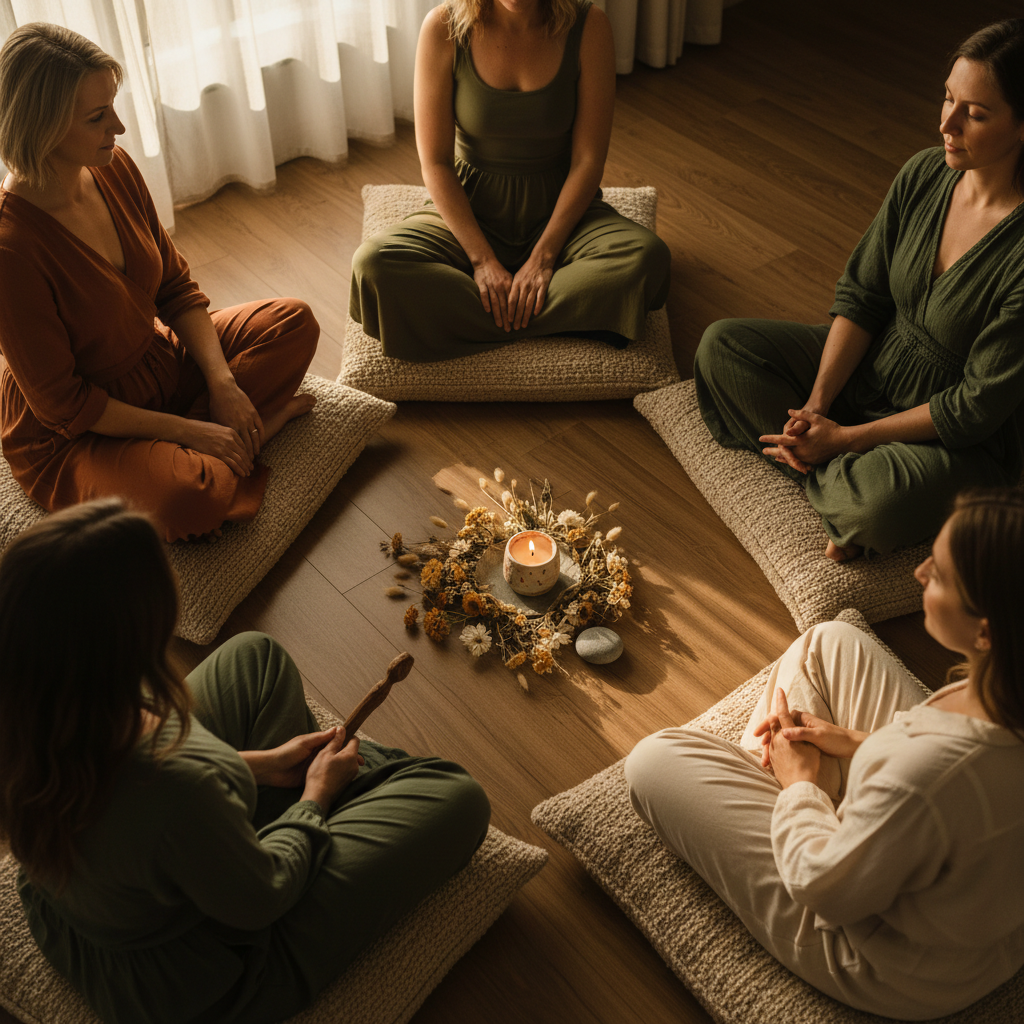
For in-person gatherings, find a quiet, private space. Living rooms work beautifully. Arrange seating in a circle, not around a table. A centerpiece with a candle signals to the nervous system that this space is different.
Virtual circles require different preparation. Use gallery view so everyone sees each other. Ask participants to find a private spot. Build in explicit check-ins: “How are you arriving tonight?” with 60 seconds per person closes much of the intimacy gap. Hybrid models are tempting but tricky, as in-person attendees tend to form a subgroup. If you go hybrid, assign a dedicated virtual host.
| Element | In-Person Circle | Virtual Circle |
|---|---|---|
| Best for | Deep sensory ritual, physical connection | Geographic reach, accessibility, caregivers |
| Ideal group size | 5-8 women | 4-7 women (smaller for screen intimacy) |
| Setup time | 20-30 minutes | 10 minutes for tech check |
| Ritual adaptation | Full sensory (candles, objects, music) | Adapted (each woman lights own candle at home) |
| Biggest challenge | Finding consistent private space | Maintaining intimacy through screens |
Creating a Safe Space and Facilitating With Confidence
Psychological safety isn’t built by avoiding hard topics; it’s built by establishing clear agreements before those topics surface. Aim for three to five shared agreements the group creates together in the first ten minutes:
Confidentiality. Share your own experience outside this room, but never anyone else’s story or details.
“I” statements. “I feel” and “I experienced” rather than “You should.”
No cross-talk during shares. The speaker holds the floor until she’s done.
Right to pass. Any woman can pass on any prompt, any time, without explanation.
Presence over perfection. Phones away. Full attention.
Effective circle facilitation means guiding energy and attention rather than teaching or lecturing, using open-ended prompts and reflective listening to let the group’s wisdom lead. You’re not running a workshop. You’re tending a fire.
The talking stick method, where only the person holding a designated object may speak, solves 80% of dominance issues without confrontation. For the rest, gentle redirection works: “Thank you for sharing. Let’s make sure we hear from everyone tonight.”
And here’s something most facilitation guides won’t tell you: the awkward silences are working. Silence isn’t failure. It’s processing. If you rush to fill it, you steal the moment before someone finds the courage to say the thing she’s never said aloud.
Handling Emotional Triggers and Trauma Responses
When a participant becomes emotionally activated, the facilitator’s job is to normalize the pause, offer a grounding technique like five slow breaths or feet-on-floor awareness, and never pressure disclosure or resolution. This is the foundation of trauma-informed facilitation.
Before your first gathering, identify two or three mental health resources you can share privately: a crisis hotline, a sliding-scale therapist directory, a social good project or community resource.
Grounding techniques every facilitator should know:
- Five-breath reset. In for four counts, hold for four, out for six. Do it together as a group.
- Feet-on-floor awareness. “Press your feet down. Notice the texture beneath you.” This pulls attention from emotional flooding back into the body.
- Name five things. A classic exercise from the National Institute of Mental Health that interrupts the trauma loop by engaging the senses.
When a woman is crying, don’t rush to fix it. Say: “You’re safe here. Take whatever time you need.” Don’t touch without asking.
| Scenario | What to Do | What NOT to Do |
|---|---|---|
| Crying | “You’re safe here. Take your time.” Wait. | Rush to hug, offer advice, or redirect |
| Trauma disclosure | Thank her for trusting the group. Don’t probe. | Ask follow-up questions |
| Dissociation | Offer grounding to the whole group | Single her out |
| Conflict between members | Acknowledge both perspectives. Return to agreements. | Take sides |
| Someone wants to leave | Let her go. Check in privately later. | Block the exit or guilt-trip |
The hardest part of trauma-informed facilitation is accepting you can’t fix everything in the room. That boundary protects you and protects the circle from becoming dependent on one person’s emotional labor.
Circle Rituals and Practices: Opening, Closing, and Flow
Circle rituals separate a women’s empowerment circle from a casual hangout. They signal: “This space is different.” The rituals don’t need to be elaborate. They just need to be intentional.
Opening: Light a candle. Invite each woman to share a single word capturing what she’s bringing tonight. Take three synchronized breaths together. Research from the National Institutes of Health confirms that controlled breathing activates the parasympathetic nervous system, reducing cortisol and increasing feelings of safety.
Sharing: Use a talking stick. Pass it clockwise with a two-to-three-minute suggestion per person. Always offer the option to pass. The practice of listening more and talking less transforms conversation into communion.
Closing: A gratitude round, a collective affirmation spoken in unison (“Our circle is closed, our connection continues”), and extinguishing the candle.
| Time | Activity | Purpose |
|---|---|---|
| 0-5 min | Candle lighting and welcome | Set the container |
| 5-15 min | Intention setting (one word each) | Ground the group |
| 15-25 min | Icebreaker prompt | Build connection |
| 25-45 min | Guided sharing | Deepen conversation |
| 45-55 min | Gratitude round | Close with warmth |
| 55-60 min | Affirmation and candle extinguishing | Mark the ending |
Keep your first circle to sixty minutes. Here’s the paradox of circle work: the less you try to accomplish in a single gathering, the more transformation happens over time.
Sustaining Momentum and Growing Your Circle Long-Term
Starting a circle is the easy part. Keeping it alive is where real craft lives.
The number one reason circles fade isn’t conflict. It’s facilitator burnout. The fix is structural: rotate leadership, invite members to co-facilitate, and share logistics. Shared ownership deepens connection because everyone’s invested in building it.
Gather feedback every third or fourth gathering. Celebrate milestones together. A circle that celebrates together stays together. As trust deepens, introduce somatic practices, creative expression, or themed gatherings. The social good projects that grow from circles like these often surprise everyone.
Finding members doesn’t require a marketing budget. Word of mouth remains worth its weight in gold because personal referrals carry built-in trust. Post in local Facebook groups with a simple, honest invitation. Use community boards at libraries and yoga studios. Partner with women’s shelters or mentorship programs.
| Recruitment Channel | Best For | Effort | Reach |
|---|---|---|---|
| Social media groups | Broad local awareness | Low | High |
| Community boards | Neighborhood targeting | Low | Medium |
| Word of mouth | High-trust referrals | Medium | Low-Medium |
| Partner organizations | Pre-aligned audiences | Medium | Medium-High |
| Free intro session | Converting curious attendees | High | Low |
Frequently Asked Questions
How do I facilitate a women’s circle without it feeling awkward?
Start with a simple opening ritual and clear agreements so everyone knows what to expect. Awkwardness fades when the facilitator models vulnerability first and doesn’t pretend to have all the answers. Use structured sharing prompts rather than open-ended “so, who wants to go first?” moments. A talking stick gives natural structure. If you feel nervous, say so. That honesty is disarming and gives everyone permission to be imperfect.
What structure works best for a first meeting?
Keep the first session between sixty and ninety minutes with a brief opening ritual, introductions, a guided sharing prompt, and a closing circle. Use low-pressure icebreakers like “share one thing that brought you joy this week.” The goal of the first gathering isn’t transformation. It’s trust. Everything else builds from there.
How do you handle dominant personalities?
Use a talking stick or timed sharing rounds to give every participant equal space. Phrases like “we practice equal voice” establish the norm before any issue arises. If someone consistently takes more than their share, gently redirect: “Thank you for sharing. Let’s make sure everyone has a chance.” Most dominant speakers aren’t intentionally monopolizing. Structure channels enthusiasm without shaming anyone.
How do you create psychological safety in a group of strangers?
Establish explicit confidentiality agreements before any personal sharing begins. Frame these as agreements rather than rules, because shared ownership increases buy-in. Normalize silence. Always offer a pass option. Model non-judgmental listening yourself. According to Harvard Business Review’s research on psychological safety, groups perform best when members feel safe to take interpersonal risks.
How do you keep a circle going long-term?
Rotate themes, invite guest facilitators, and regularly collect member feedback. Consistent scheduling matters more than frequency. A monthly circle that never moves dates builds stronger habits than a weekly one that constantly reschedules. Shared ownership of planning prevents burnout. Don’t be afraid to let the circle evolve.
Is certification needed to run a women’s circle?
No formal certification is required. You can start this week with nothing more than a genuine desire to create space for connection. That said, trauma-informed facilitation courses are valuable investments. Organizations like the Center for Council offer training rooted in council practice traditions. The permission to begin doesn’t come from a certificate. It comes from your willingness to show up and learn as you go.
—
How do you handle dominant personalities who take over the group dynamic?
Use a talking stick or timed sharing rounds to give every participant equal space to speak. Set clear group agreements upfront about balanced participation, and gently redirect during sessions if one voice begins to dominate—this prevents resentment and ensures all members feel heard.
What is the purpose of a women’s empowerment circle and how is it different from a support group?
A women’s empowerment circle focuses on collective growth, leadership, and connection rather than treating a specific issue or challenge. Support groups typically address defined problems like grief or addiction, while circles center on shared intention, ritual, and mutual uplift across diverse life experiences.
Where do I find women who are genuinely interested in joining a circle?
Post in local community groups, women-focused social media spaces, and neighborhood boards to attract aligned members. You can also partner with yoga studios, libraries, or women’s organizations and host a free introductory session to help potential members experience the circle’s energy firsthand.
Can men facilitate women’s circles or should it always be woman-led?
Most practitioners recommend woman-led facilitation because shared lived experience deepens trust and safety within the circle space. Male allies can support logistics or co-facilitate in specific contexts, but centering women’s voices and perspectives as primary facilitators strengthens the container for authentic sharing.
What topics should be covered in a women’s empowerment circle?
Common topics include self-worth, boundaries, leadership, body image, financial empowerment, and creative expression. Topics should rotate based on member needs and can be chosen collaboratively each cycle, ensuring the circle evolves with the group’s collective priorities.
What are common opening and closing rituals for a women’s circle?
Popular opening rituals include candle lighting, intention setting, and a moment of collective breathing to transition into sacred space. Closing rituals might include gratitude rounds, group affirmations, or extinguishing the candle together to mark the return to everyday life.
How do you handle emotional triggers and trauma responses during a circle?
Pause the flow, offer grounding techniques like deep breathing, and check in privately with the participant afterward. Have mental health referral resources available and never pressure someone to share beyond their comfort level—emotional safety means honoring each person’s pace and boundaries.
Your Circle Is Already Waiting
The women who start circles aren’t the ones with the most training. They’re the ones who simply decide to begin.
You don’t need a perfect space or a certification on your wall. You need a candle, a few honest agreements, and the willingness to sit in a circle and listen. The women who will join are already out there, craving exactly the kind of real sisterhood a women’s empowerment circle provides. They just don’t know it exists yet, because nobody’s invited them.
So be the one who invites them. Light the candle. Pass the talking stick.
—
By Spread Love.org Editorial Team | Last updated: October 2026
The Spread Love.org Editorial Team creates resources at the intersection of community building, women’s leadership, and social impact. Our work is rooted in the belief that intentional connection transforms lives, neighborhoods, and systems. Learn more about our mission.